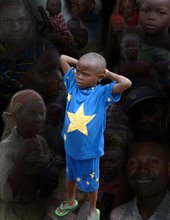
In the past week I have twice had children scrounging through the refuse of what I have failed to eat. Life, it seems, is augmented by moments of ephemeral clarity that indelibly drive truths about love and joy and suffering into the fabric of our lives. It may be that moment in some song or in the pages of a heart-wrenching parable that shoves a lump into one’s throat and ends with tears trickling through trembling hands to muddy the dusty tennis-shoes below. Maybe it is watching ashen dust billow out from a vehicle as it winds it way through some barren wasteland at the dusk of the day, or that moment when you walk outside and gasp at the sprinkling of diamonds in the sky. Perhaps it is the scent of a rose or a hug when you needed one; for each of us these moments come in there own way and timing.
For me, these moments have often involved children in one way or another; whether it is children recklessly abandoning themselves in their parents embrace, running wild at play or the desperate look of a mother watching over her sick child. Children are the easiest examples of joy and contentment we can find around us and perhaps because of this, they also offer the starkest view of our troubled world.
Several days ago I was enjoying a relaxing moment on our kitchen porch when a small band of children came wandering up to our compound and began to sift through the garbage pit that lies just outside our fence. They eagerly shuffled through the mess that is there, looking for plastic soda bottles and anything else they deemed valuable before wandering off in search of valuables elsewhere. A few days later, I was eating outside near a street in a town north of here when a small boy approached our table as we were finishing. He looked rather pitifully at us and gestured at what remained on our table. We nodded, and he quickly grabbed what remained of the food and walked across the street to devour it. I had been contemplating eating a small ice-cream that was just handed to me…ice-cream never tasted worse!
We live in a world where children get excited about finding plastic soda bottles and are hungry enough to scrounge for food from strangers’ plates. I don’t have any answers. Everywhere I go I find hungry children, children dying from curable diseases and children who spend there days sorting through trash. Most of these children are happy if all I do is wave to them….I want to do so much more.
There are those moments of clarity when we can see such goodness and beauty around us, and there are those moments when we realize all too clearly that things are desperately out of order; moments that break our hearts, even as our King’s heart is broken. I hope I have the courage to respond as my King responds.
Friday, January 23, 2009

Sunday, January 18, 2009
Jan 9 - CPA Day!
On January 9th we celebrated the CPA(Comprehensive Peace Agreement) here in South Sudan. It was a celebration of 4 years of peace. There were a lot of traditional dances and a few speeches highlighting the importance of continuing the peace. Here are some pictures from the day. Enjoy!


Saturday, December 27, 2008
Looking Back
It seems, this time of year, a lot of time is spent looking back. We look back on memories from years ago and we look back on the past year and, as is often the case, we are left to wonder how we ever made it to where we are at. As I look back on this past year, I am amazed by all that has happened and the strength that has been given to press on.
I am sure if you were to go back through my posts from this year you might begin to wonder if anything good ever happens in Sudan. I have experienced two destructive fires, a wind that blew the roof off our operating theatre, traveled through mud and dust over countless miles of ruts referred to as roads and had encounters with people who are at times more than frustrating to deal with. I, myself, have at times wondered if Sudan ever offers anything but calamity to those who live within its borders, and have spent many sleepless nights listening to the rats rustle through the thatch above my head while questioning how I ever ended up in such a backward place.
I am reminded, however, that the King did not enter a world that had its act together, but rather, he entered as light into darkness; as a breath of sanity in the midst of our insanity. We like to sing Christmas carols such as “Silent Night” and “O Holy Night” that make us think of Christ’s birth as the most serene moment in history, when in fact it, if some thought is given to the event one would be led to believe that it was most likely far from tranquil. The Author of creation, mother screaming in pain, came wailing into the world covered in birth and all that it entails, and like all new born children must have wondered at what an awfully uncomfortable place this was. Sure, there were shepherds, wisemen and angels, but there was also infanticide, a daring escape and refugee status without the UNHCR to hand out free food and blankets. Our King did not enter the world of storybook and legend, he entered OUR world; the world where we sit in the filth of our humanity, dripping with the wretchedness of our vain efforts to fix ourselves, in desperate need of a Savior.
I have had the immense privilege to be at home in Uganda with my family for Christmas. Christmas day was spent having fun in the warm waters of Lake Victoria but also came with the sad reminder of the fallen world we live in. We received news that our “home” village in Congo, Faradje, was attached by the Ugandan LRA rebel group. Our friends’ homes were burned down and many people were killed and abducted. This news has brought with it a strong mix of emotions. I find myself angry that such atrocities are committed and frustrated by my own inability to do anything about it. We do, indeed, live in a monumental mess of a world!!
This morning, a Congolese pastor friend mentioned that the story of David and Goliath has been a great encouragement to him as he looks at the troubles in Congo and his testimony has in turn encouraged me as I think of my work in Sudan and the continuing violence in Congo. The Israelites were afraid of the pagan giant and out of the bush walked a boy with a sling and some rocks to take him down. David didn’t see the giant, he saw the Great Shaddai (Almighty) and took up His battle cry. Our King entered our crazy world to give us hope and light. Sometimes it is daunting living in this world so full of darkness, but we have such a wonderful opportunity to face this darkness with the light that has been so freely given to us. May it be so.
I am sure if you were to go back through my posts from this year you might begin to wonder if anything good ever happens in Sudan. I have experienced two destructive fires, a wind that blew the roof off our operating theatre, traveled through mud and dust over countless miles of ruts referred to as roads and had encounters with people who are at times more than frustrating to deal with. I, myself, have at times wondered if Sudan ever offers anything but calamity to those who live within its borders, and have spent many sleepless nights listening to the rats rustle through the thatch above my head while questioning how I ever ended up in such a backward place.
I am reminded, however, that the King did not enter a world that had its act together, but rather, he entered as light into darkness; as a breath of sanity in the midst of our insanity. We like to sing Christmas carols such as “Silent Night” and “O Holy Night” that make us think of Christ’s birth as the most serene moment in history, when in fact it, if some thought is given to the event one would be led to believe that it was most likely far from tranquil. The Author of creation, mother screaming in pain, came wailing into the world covered in birth and all that it entails, and like all new born children must have wondered at what an awfully uncomfortable place this was. Sure, there were shepherds, wisemen and angels, but there was also infanticide, a daring escape and refugee status without the UNHCR to hand out free food and blankets. Our King did not enter the world of storybook and legend, he entered OUR world; the world where we sit in the filth of our humanity, dripping with the wretchedness of our vain efforts to fix ourselves, in desperate need of a Savior.
I have had the immense privilege to be at home in Uganda with my family for Christmas. Christmas day was spent having fun in the warm waters of Lake Victoria but also came with the sad reminder of the fallen world we live in. We received news that our “home” village in Congo, Faradje, was attached by the Ugandan LRA rebel group. Our friends’ homes were burned down and many people were killed and abducted. This news has brought with it a strong mix of emotions. I find myself angry that such atrocities are committed and frustrated by my own inability to do anything about it. We do, indeed, live in a monumental mess of a world!!
This morning, a Congolese pastor friend mentioned that the story of David and Goliath has been a great encouragement to him as he looks at the troubles in Congo and his testimony has in turn encouraged me as I think of my work in Sudan and the continuing violence in Congo. The Israelites were afraid of the pagan giant and out of the bush walked a boy with a sling and some rocks to take him down. David didn’t see the giant, he saw the Great Shaddai (Almighty) and took up His battle cry. Our King entered our crazy world to give us hope and light. Sometimes it is daunting living in this world so full of darkness, but we have such a wonderful opportunity to face this darkness with the light that has been so freely given to us. May it be so.
Saturday, December 6, 2008
More Fires, Etc....
Some of you, I am sure, have been wondering where I have disappeared to for the last little while. For those of you who have been eagerly awaiting my next post…I apologize.
A lot has happened since my last post, and you would think that it would give me lots to write about, which on one hand it does, but on the other hand it has meant that I have been super busy. Two weeks ago I got back from my R&R in Kenya where I was able to spend some time with my parents and cousins which was great fun. We went go-carting for my birthday and tried to crash each other into the tire walls. I was also able to go up to Rift Valley Academy, my former high school, where I spent a few days hanging out with two of my former classmates who are on staff as well as with some former teachers. It was good to go back and see how much has changed and to realize how much I have changed since my time there. It was also nice to spend some time in the pottery room working on some coffee mugs, which is something I really enjoy doing.
When I got back here there was a lot of work waiting for me. Angelo, our program manager, went to the states as I came back from Kenya which left me in charge. We are currently finishing up a building project at the hospital while also trying to start one at a school in town. At the same time we are also running our usual projects around town. A few days after I got back I had to travel north for an important government meeting as well as to purchase some supplies for our compound. When I returned our school had its closing ceremony which I needed to attend so that I could give a speech on behalf of our organization. The next day I was invited to give another speech at a neighboring school that was also closing. As you may have guessed, Sudanese love speeches.
The second speech day was also Thanksgiving. We were able to get a turkey from Kenya and I am quite proud to say that I successfully figured out how to cook it in our small gas oven. We had a few guests over to celebrate, and in spite of the speech giving, we were able to take most of the day off. I celebrated by taking a nap in the 100 degree heat in my hammock on the porch. I would have willingly shared some of my heat with many of you farther north suffering in the cold!
Last Friday brought about some big changes to our compound. I traveled south to our farm project and as I was returning I noticed a large column of smoke in the distance. It seemed to be coming from the direction of our compound and I thought that perhaps it was the hill behind our compound burning, because it still had a lot of dry grass on it. A few minutes later I received a frantic call from one of my colleagues urging me to get back to our compound as it was on fire. I rushed back as fast as the bumpy road would allow and arrived to see smoke rising from all corners of our compound. I ran past our burning fence and arrived in time to watch one of our tukols finish burning to the ground. I walked around a bit dazed for a few minutes and utterly overwhelmed; almost all of our fence was burned down, we had lost two tukols, three latrines, two storerooms and we had many fuel drums that burned for hours. We fought out the remaining fire on the fences as it traveled near to the tukols but stayed far from the fuel storeroom as it went up in a blaze of Av-gas, Diesel, Petrol and Jet-A One. At one point a cylinder of Acetylene, which is used for gas welding, exploded causing quite a stir among those of us watching.
As a team, my colleagues and I gathered to give thanks to our King that no one was injured. The fire had come with a fierce wind that was essentially unstoppable and in so many ways it was a miracle that no one was injured. We do not understand why things like this happen but we do know that God is in control. Throughout this ordeal it has been amazing to revel in the grace God has given me in dealing with this situation. He has given me strength and wisdom when I have needed them and provided patience and the will to persevere.
Below you’ll find some pictures of the fire. Most of them are from colleagues (David Bock and Sammy Muraya) who were able to get pictures before our compound was on fire and during the attempts to put it out. The pictures from the day after the fire are mine.

The fire came from the north-west and went up the hill next to us.

Pushed by a strong wind it also approached our compound.

Once the fence was on fire, the wind carried the fire toward our storerooms.

It also carried it toward our tukols. Mine is the one in the middle of these burning fences.

The wind pushed the fire from one fence to another. (All our fences were made of grass.)

The wind pushed the fire from one of the fences onto our doctor's tukol.

I had been visiting our farm and arrived quite overwhelmed.

We had a several barrels of fuel that caught fire. Not to mention many empty barrels of Jet-A One.

We lost several quad-bikes in the fire.

We gathered to give thanks that no one was hurt.

This was our fuel storeroom.

Quadbike

Latrine

Looking at the hill.

Gaurd Tukol.

Generator/Welder

Looking at our compound from the burned hill.

The fence.


Blown up Acetylene tank.
A lot has happened since my last post, and you would think that it would give me lots to write about, which on one hand it does, but on the other hand it has meant that I have been super busy. Two weeks ago I got back from my R&R in Kenya where I was able to spend some time with my parents and cousins which was great fun. We went go-carting for my birthday and tried to crash each other into the tire walls. I was also able to go up to Rift Valley Academy, my former high school, where I spent a few days hanging out with two of my former classmates who are on staff as well as with some former teachers. It was good to go back and see how much has changed and to realize how much I have changed since my time there. It was also nice to spend some time in the pottery room working on some coffee mugs, which is something I really enjoy doing.
When I got back here there was a lot of work waiting for me. Angelo, our program manager, went to the states as I came back from Kenya which left me in charge. We are currently finishing up a building project at the hospital while also trying to start one at a school in town. At the same time we are also running our usual projects around town. A few days after I got back I had to travel north for an important government meeting as well as to purchase some supplies for our compound. When I returned our school had its closing ceremony which I needed to attend so that I could give a speech on behalf of our organization. The next day I was invited to give another speech at a neighboring school that was also closing. As you may have guessed, Sudanese love speeches.
The second speech day was also Thanksgiving. We were able to get a turkey from Kenya and I am quite proud to say that I successfully figured out how to cook it in our small gas oven. We had a few guests over to celebrate, and in spite of the speech giving, we were able to take most of the day off. I celebrated by taking a nap in the 100 degree heat in my hammock on the porch. I would have willingly shared some of my heat with many of you farther north suffering in the cold!
Last Friday brought about some big changes to our compound. I traveled south to our farm project and as I was returning I noticed a large column of smoke in the distance. It seemed to be coming from the direction of our compound and I thought that perhaps it was the hill behind our compound burning, because it still had a lot of dry grass on it. A few minutes later I received a frantic call from one of my colleagues urging me to get back to our compound as it was on fire. I rushed back as fast as the bumpy road would allow and arrived to see smoke rising from all corners of our compound. I ran past our burning fence and arrived in time to watch one of our tukols finish burning to the ground. I walked around a bit dazed for a few minutes and utterly overwhelmed; almost all of our fence was burned down, we had lost two tukols, three latrines, two storerooms and we had many fuel drums that burned for hours. We fought out the remaining fire on the fences as it traveled near to the tukols but stayed far from the fuel storeroom as it went up in a blaze of Av-gas, Diesel, Petrol and Jet-A One. At one point a cylinder of Acetylene, which is used for gas welding, exploded causing quite a stir among those of us watching.
As a team, my colleagues and I gathered to give thanks to our King that no one was injured. The fire had come with a fierce wind that was essentially unstoppable and in so many ways it was a miracle that no one was injured. We do not understand why things like this happen but we do know that God is in control. Throughout this ordeal it has been amazing to revel in the grace God has given me in dealing with this situation. He has given me strength and wisdom when I have needed them and provided patience and the will to persevere.
Below you’ll find some pictures of the fire. Most of them are from colleagues (David Bock and Sammy Muraya) who were able to get pictures before our compound was on fire and during the attempts to put it out. The pictures from the day after the fire are mine.

The fire came from the north-west and went up the hill next to us.

Pushed by a strong wind it also approached our compound.

Once the fence was on fire, the wind carried the fire toward our storerooms.

It also carried it toward our tukols. Mine is the one in the middle of these burning fences.

The wind pushed the fire from one fence to another. (All our fences were made of grass.)

The wind pushed the fire from one of the fences onto our doctor's tukol.

I had been visiting our farm and arrived quite overwhelmed.

We had a several barrels of fuel that caught fire. Not to mention many empty barrels of Jet-A One.

We lost several quad-bikes in the fire.

We gathered to give thanks that no one was hurt.

This was our fuel storeroom.

Quadbike

Latrine

Looking at the hill.

Gaurd Tukol.

Generator/Welder

Looking at our compound from the burned hill.

The fence.


Blown up Acetylene tank.
Tuesday, November 4, 2008
Cultural Wonderment
One thing that I continually find fascinating is the complexity that exists in different cultures around the world. I enjoy traveling to new places and watching how people live their lives; absorbing the beauty that exists in differing clothing, savoring the delicacies that zing the taste buds and listening to the music of each culture’s mother-tongue as people ramble on to one another with words I will probably never understand. Every once in a while though I find myself dumbfounded by the cultures I encounter. When I least expect it I am brought face-to-face with something that would never happen in my own culture (as undefined as it is, given my particular mixed-up upbringing). To explain this I thought I would use two recent examples of culturally different practices I have encountered and then add some comments on elections…since, after all, I am writing on election day.
Last week my colleague, David, returned from his work on water sanitation in a bit of a quandary. He explained that one of his workers hadn’t showed up for work and when he asked about her whereabouts he was told that she was in jail. Upon prying further he discovered that she was in jail because she had tried to run away from a marriage her mother had set up for her. It turns out she had received several gifts from the particular man involved and he had also given a substantial amount of money to the mother as a dowry payment – essentially, she didn’t have a choice in the matter. When she tried to run away, the man hired a truck, tracked her down and had her thrown in jail. After several days in jail while the families finished working out the deal she was released to go and live with the man as his second wife. David visited her several days later to give her the salary she had earned and listened to her lament about the situation she was in. Her complaint: “The first wife was beating her.”
This was a situation we found ourselves powerless to change. The girl is only about 17 years old, but even so the culture here is so accepting of the situation it is as if nothing has happened at all. Several of our most respected Sudanese staff told David that the man was completely within his rights with everything he had done. There are some things here that we simply cannot understand and at times it is heartbreaking. I am sure that this cultural practice is bound to change with time…but one can never know how long such a change could take. In the meantime seventeen year-olds are given in marriage to men who already have wives.
My second example is much lighter in content and is simply something I found somewhat amusing. We have a Nigerian family staying with us who are missionaries in an area south of here. They came here so that the wife could give birth to their second child. We have all enjoyed having them around, especially their three year-old, Praise, who is a riot. After waiting expectantly for several weeks, Victoria gave birth to a baby girl on Sunday night and we were all excited at the new arrival. Today, as I walked past one of our charcoal burners, I noticed Steve cooking something and went over to check it out. What I found was a cow foot, hoof and all, being roasted on the flames. He explained that he would make it into a huge spicy stew for his wife to eat in the coming days. It turns out that cow foot stew is a tradition for women who have just given birth in Nigeria. I’m not sure what the value of spicy cow foot is for mother and new born...and I don’t suppose I ever will.
As America goes out to vote today, I can’t help but be amazed at how blessed Americans are with our system of government and elections. With the election season in full gear we have often talked with our staff here about our system and how it will work on election day, but the fact of the matter is that in reality they cannot fully comprehend a system where people can go out and vote without fear of being shot, having their vote stolen, or having the result lead their country into civil conflict. Most Sudanese have never voted and their chance to vote in the coming years is precariously balanced atop a feeble peace agreement between the north and south. America impassively goes about it electoral duties and the rest of the world watches in wonder at something that in so many ways is a miracle.
Last week my colleague, David, returned from his work on water sanitation in a bit of a quandary. He explained that one of his workers hadn’t showed up for work and when he asked about her whereabouts he was told that she was in jail. Upon prying further he discovered that she was in jail because she had tried to run away from a marriage her mother had set up for her. It turns out she had received several gifts from the particular man involved and he had also given a substantial amount of money to the mother as a dowry payment – essentially, she didn’t have a choice in the matter. When she tried to run away, the man hired a truck, tracked her down and had her thrown in jail. After several days in jail while the families finished working out the deal she was released to go and live with the man as his second wife. David visited her several days later to give her the salary she had earned and listened to her lament about the situation she was in. Her complaint: “The first wife was beating her.”
This was a situation we found ourselves powerless to change. The girl is only about 17 years old, but even so the culture here is so accepting of the situation it is as if nothing has happened at all. Several of our most respected Sudanese staff told David that the man was completely within his rights with everything he had done. There are some things here that we simply cannot understand and at times it is heartbreaking. I am sure that this cultural practice is bound to change with time…but one can never know how long such a change could take. In the meantime seventeen year-olds are given in marriage to men who already have wives.
My second example is much lighter in content and is simply something I found somewhat amusing. We have a Nigerian family staying with us who are missionaries in an area south of here. They came here so that the wife could give birth to their second child. We have all enjoyed having them around, especially their three year-old, Praise, who is a riot. After waiting expectantly for several weeks, Victoria gave birth to a baby girl on Sunday night and we were all excited at the new arrival. Today, as I walked past one of our charcoal burners, I noticed Steve cooking something and went over to check it out. What I found was a cow foot, hoof and all, being roasted on the flames. He explained that he would make it into a huge spicy stew for his wife to eat in the coming days. It turns out that cow foot stew is a tradition for women who have just given birth in Nigeria. I’m not sure what the value of spicy cow foot is for mother and new born...and I don’t suppose I ever will.
As America goes out to vote today, I can’t help but be amazed at how blessed Americans are with our system of government and elections. With the election season in full gear we have often talked with our staff here about our system and how it will work on election day, but the fact of the matter is that in reality they cannot fully comprehend a system where people can go out and vote without fear of being shot, having their vote stolen, or having the result lead their country into civil conflict. Most Sudanese have never voted and their chance to vote in the coming years is precariously balanced atop a feeble peace agreement between the north and south. America impassively goes about it electoral duties and the rest of the world watches in wonder at something that in so many ways is a miracle.
Tuesday, October 21, 2008
When the Journey Takes Us
Sometimes the journey takes us. When we least expect it adventure, or perhaps misadventure, comes knocking at our door and before we know it the journey has taken us beyond the constraints of our imagination and the limitations of our reality to places and through places we might never have gone. The journey takes us – it pushes, stretches, pokes and prattles until we are exhausted from the effort but somehow content, as if we have learned some new secret along the way. And perhaps we have. It is always easier when we enter adventures of our own choosing but accidents happen and sometimes we find ourselves journeying along whether we want to or not and at this point attitude makes all the difference.
It is two in the morning and it looks as if we have, at last, reached a road upon which we will not get stuck. I take over the driving from Nile, who for the last thirteen hours has used every trick he can muster up to keep our truck from getting irretrievably struck in the sticky, slippery black cotton mud that seems to stretch for endless miles over this land. When we left town in the early afternoon I knew this was not going to be an easy trip but certainly wasn’t prepared for the roads that lay ahead. I should have figured it out when, after only fifteen minutes of driving, the truck slipped into seasoned ruts and the tires spun to no avail. If that wasn’t a clue then the forty-five minutes it took to get us unstuck should have been. Only after we were stuck again, one kilometer down the road, did I truly begin to suspect I was in for more than I had bargained for. Nothing could have prepared me for the two feet of mud that stuck cylindrically out from the wheel rims of our truck, or the trenches left in the road by overloaded tractors, or the roads we had to blaze through ten foot tall grass. I definitely wasn’t prepared to winch the truck out of a hole every other hour.
In situations like this the sun always sets too soon, and it did for us. Finding a road through the mud is difficult enough in the daylight and once the sun goes down it is like living in a nightmare; a nightmare that continues on through river beds, sorghum fields and sleeping villages that appear out of the bush like a birthday surprise you never saw coming. The moon is almost full, but when you are scouring for stones to place beneath your sinking tires, it is hard to look past the light it provides to the beauty of the cool, clear evening, accentuated by crickets in song and the murmur from distance villages dancing to celebrate the season of fire.
We persevered, continuing on through the hours of the night; slipping and sliding our way around tree stumps, swampy sink holes and past silhouetted mountains. It was only after the third time being stuck, that the hand-winch began to work, and as we plotted along, with exhaustion setting in, we were grateful it had finally worked. Attaching it to resilient thorn trees, we pulled our selves from the trenches time and time again.
As we drive along, now sailing down the packed gravel road, it is hard to stay focused on the driving. Nile, sitting next to me, is nodding off to sleep and every time I hit the brakes or a bump in the road his head goes swinging wildly forward. Gorshi stays awake to keep me company, throwing out a random comment now and again that keeps me from drifting off in my thoughts which wander aimlessly through the events of the day and the night as it continues to unfold. Rabbits and stray, mangy dogs dart off the road as my headlights hit them, and as the giant moon drifts off into the western sky it illuminates small encampments of the nomadic Falata people, their cows with giant horns resting quietly near their dome-like tents.
It is not long before I can see, in the far reaches of my headlights, the disaster that has brought about this journey. I slow to a halt, fixing the lights on the bent frame of a red, Honda quadbike that has been pushed to the side of the road. One tire has come loose from the steering rod and rests crookedly beneath the vehicle. The seat has come off entirely and the battery that lies below it is broken in two. We scour the area looking for clues and decide that a nearby dip in the road must have been the cause, sending the quadbike crashing out of control. The injured persons have long since been taken to a nearby hospital, having suffered head injuries and severe scrapes and bruises. It is no wonder, given the state of the quadbike. It is for them that we have journeyed through the night, persevering to ensure that they receive proper treatment and the attention that their injuries require.
We continue on toward morning, bouncing down the dry, empty road. In the west the moon begins to set and the eastern sky shifts from the black of night to the indigo indicative of the approaching dawn. At five we stop to rest for an hour, drawing the vehicle to a stop at a vacant roadside market. Gorshi scrounges in a nearby tea house for a small grass-woven bed and falls asleep near the truck. Nile finds a mat and joins him. I spread out across the seats and try to sleep but despite the hours without rest, I find it hard to relax and give up completely when donkey drawn water carts begin to roam the small village. The Muslim call to prayer chants its way into my morning subconscious and it is time to get moving again.
After only an hour, we enter Damazin as the small city is beginning to stir. The streets are dotted with tea and coffee shops; women in headscarves sit behind petite pots of boiling brew and serve it in miniature cups to lounging customers as they slowly ease their way into the day. We dodge potholes, tuk-tuks, donkeys and horse-drawn carts as we weave our way down the narrow streets to the guesthouse that awaits our arrival. We pull up just as most of the guests are heading out for their daily duties and are warmly greeted and congratulated on the feat we have just accomplished in having made it at all. We prepare to unpack and shower with the intention of visiting our injured colleague as soon as possible. As we unpack my phone rings and a friend on the other end informs me that our colleague has been transferred to Khartoum during the night. I thank him for the information and try to hide my frustration at having just driven sixteen hours for nothing. We cannot quite understand why our friend has chosen to go north in the night when we have already arranged transportation to Kenya for him but decide not to dwell on the events we could not control.
It only takes a few minutes to unpack and shower, and after a quick call to my boss I find myself fast asleep. It is a sleep like none I’ve had in a long time; deep, dreamless sleep unaware at all of the passing of time.
Monday and Tuesday pass by in a blur. We have tried and failed to meet up with our injured comrade and we have tried and failed in our endeavors to return home. The quadbike is now loaded in the back of the pickup and after a day of rain our attempts at continuing toward home have met with more mud than we wish to endure. We have stopped half-way as we wait for the road to dry and for our tractor to come and pull us through the quagmire. A compassionate villager offers us his house for the night and we enjoy a restful sleep, lulled by the songs sifting through the calm air from the full moon dance.
Our tractor arrives and we begin the final journey; the journey home. Our way is much simpler now that the road has dried and we have the sun to see by. Places where we have gotten bogged down before are avoided but still this road is far too great an obstacle for us to avoid getting stuck. The tractor pulls us out again and again but for once we don’t have to spend so much time digging or cranking the hand winch. The tractor also blazes new trails for us in the worst places, going far around the trenches left in the hardening soil by bigger vehicles than ours. As we travel the skies begin to build up with thunderstorms and the vehicle echoes our prayers that we will arrive without rain to wash away the road. We drive on, apprehensively watching the skies. Where the road is good the tractor is left to catch up with us later and we press on toward home.
As we near home, we inevitably get stuck once again. This time we power the winch as if our lives depend on it; we want nothing more than this journey’s end. Our path takes us through town and people stare at us in wonderment, as if they have never seen a vehicle so covered in mud before. We reach home to the astonished congratulations of our colleagues who can’t believe we have actually made it. And then, of course, at this our journey’s end, it rains. It really rains; the kind of rain that comes down in buckets until the whole ground is a river moving somewhere and everything is wet. And as it rains I am happy to be home; happy to have journeyed and to have learned a thing or two about perseverance and patience. And, of course, about why never to travel in rainy season again!
It is two in the morning and it looks as if we have, at last, reached a road upon which we will not get stuck. I take over the driving from Nile, who for the last thirteen hours has used every trick he can muster up to keep our truck from getting irretrievably struck in the sticky, slippery black cotton mud that seems to stretch for endless miles over this land. When we left town in the early afternoon I knew this was not going to be an easy trip but certainly wasn’t prepared for the roads that lay ahead. I should have figured it out when, after only fifteen minutes of driving, the truck slipped into seasoned ruts and the tires spun to no avail. If that wasn’t a clue then the forty-five minutes it took to get us unstuck should have been. Only after we were stuck again, one kilometer down the road, did I truly begin to suspect I was in for more than I had bargained for. Nothing could have prepared me for the two feet of mud that stuck cylindrically out from the wheel rims of our truck, or the trenches left in the road by overloaded tractors, or the roads we had to blaze through ten foot tall grass. I definitely wasn’t prepared to winch the truck out of a hole every other hour.
In situations like this the sun always sets too soon, and it did for us. Finding a road through the mud is difficult enough in the daylight and once the sun goes down it is like living in a nightmare; a nightmare that continues on through river beds, sorghum fields and sleeping villages that appear out of the bush like a birthday surprise you never saw coming. The moon is almost full, but when you are scouring for stones to place beneath your sinking tires, it is hard to look past the light it provides to the beauty of the cool, clear evening, accentuated by crickets in song and the murmur from distance villages dancing to celebrate the season of fire.
We persevered, continuing on through the hours of the night; slipping and sliding our way around tree stumps, swampy sink holes and past silhouetted mountains. It was only after the third time being stuck, that the hand-winch began to work, and as we plotted along, with exhaustion setting in, we were grateful it had finally worked. Attaching it to resilient thorn trees, we pulled our selves from the trenches time and time again.
As we drive along, now sailing down the packed gravel road, it is hard to stay focused on the driving. Nile, sitting next to me, is nodding off to sleep and every time I hit the brakes or a bump in the road his head goes swinging wildly forward. Gorshi stays awake to keep me company, throwing out a random comment now and again that keeps me from drifting off in my thoughts which wander aimlessly through the events of the day and the night as it continues to unfold. Rabbits and stray, mangy dogs dart off the road as my headlights hit them, and as the giant moon drifts off into the western sky it illuminates small encampments of the nomadic Falata people, their cows with giant horns resting quietly near their dome-like tents.
It is not long before I can see, in the far reaches of my headlights, the disaster that has brought about this journey. I slow to a halt, fixing the lights on the bent frame of a red, Honda quadbike that has been pushed to the side of the road. One tire has come loose from the steering rod and rests crookedly beneath the vehicle. The seat has come off entirely and the battery that lies below it is broken in two. We scour the area looking for clues and decide that a nearby dip in the road must have been the cause, sending the quadbike crashing out of control. The injured persons have long since been taken to a nearby hospital, having suffered head injuries and severe scrapes and bruises. It is no wonder, given the state of the quadbike. It is for them that we have journeyed through the night, persevering to ensure that they receive proper treatment and the attention that their injuries require.
We continue on toward morning, bouncing down the dry, empty road. In the west the moon begins to set and the eastern sky shifts from the black of night to the indigo indicative of the approaching dawn. At five we stop to rest for an hour, drawing the vehicle to a stop at a vacant roadside market. Gorshi scrounges in a nearby tea house for a small grass-woven bed and falls asleep near the truck. Nile finds a mat and joins him. I spread out across the seats and try to sleep but despite the hours without rest, I find it hard to relax and give up completely when donkey drawn water carts begin to roam the small village. The Muslim call to prayer chants its way into my morning subconscious and it is time to get moving again.
After only an hour, we enter Damazin as the small city is beginning to stir. The streets are dotted with tea and coffee shops; women in headscarves sit behind petite pots of boiling brew and serve it in miniature cups to lounging customers as they slowly ease their way into the day. We dodge potholes, tuk-tuks, donkeys and horse-drawn carts as we weave our way down the narrow streets to the guesthouse that awaits our arrival. We pull up just as most of the guests are heading out for their daily duties and are warmly greeted and congratulated on the feat we have just accomplished in having made it at all. We prepare to unpack and shower with the intention of visiting our injured colleague as soon as possible. As we unpack my phone rings and a friend on the other end informs me that our colleague has been transferred to Khartoum during the night. I thank him for the information and try to hide my frustration at having just driven sixteen hours for nothing. We cannot quite understand why our friend has chosen to go north in the night when we have already arranged transportation to Kenya for him but decide not to dwell on the events we could not control.
It only takes a few minutes to unpack and shower, and after a quick call to my boss I find myself fast asleep. It is a sleep like none I’ve had in a long time; deep, dreamless sleep unaware at all of the passing of time.
Monday and Tuesday pass by in a blur. We have tried and failed to meet up with our injured comrade and we have tried and failed in our endeavors to return home. The quadbike is now loaded in the back of the pickup and after a day of rain our attempts at continuing toward home have met with more mud than we wish to endure. We have stopped half-way as we wait for the road to dry and for our tractor to come and pull us through the quagmire. A compassionate villager offers us his house for the night and we enjoy a restful sleep, lulled by the songs sifting through the calm air from the full moon dance.
Our tractor arrives and we begin the final journey; the journey home. Our way is much simpler now that the road has dried and we have the sun to see by. Places where we have gotten bogged down before are avoided but still this road is far too great an obstacle for us to avoid getting stuck. The tractor pulls us out again and again but for once we don’t have to spend so much time digging or cranking the hand winch. The tractor also blazes new trails for us in the worst places, going far around the trenches left in the hardening soil by bigger vehicles than ours. As we travel the skies begin to build up with thunderstorms and the vehicle echoes our prayers that we will arrive without rain to wash away the road. We drive on, apprehensively watching the skies. Where the road is good the tractor is left to catch up with us later and we press on toward home.
As we near home, we inevitably get stuck once again. This time we power the winch as if our lives depend on it; we want nothing more than this journey’s end. Our path takes us through town and people stare at us in wonderment, as if they have never seen a vehicle so covered in mud before. We reach home to the astonished congratulations of our colleagues who can’t believe we have actually made it. And then, of course, at this our journey’s end, it rains. It really rains; the kind of rain that comes down in buckets until the whole ground is a river moving somewhere and everything is wet. And as it rains I am happy to be home; happy to have journeyed and to have learned a thing or two about perseverance and patience. And, of course, about why never to travel in rainy season again!
Wednesday, October 8, 2008
Pirates and the Sud
Click here to know why a group of pirates are playing a big role in raising tensions in this area.
Subscribe to:
Posts (Atom)